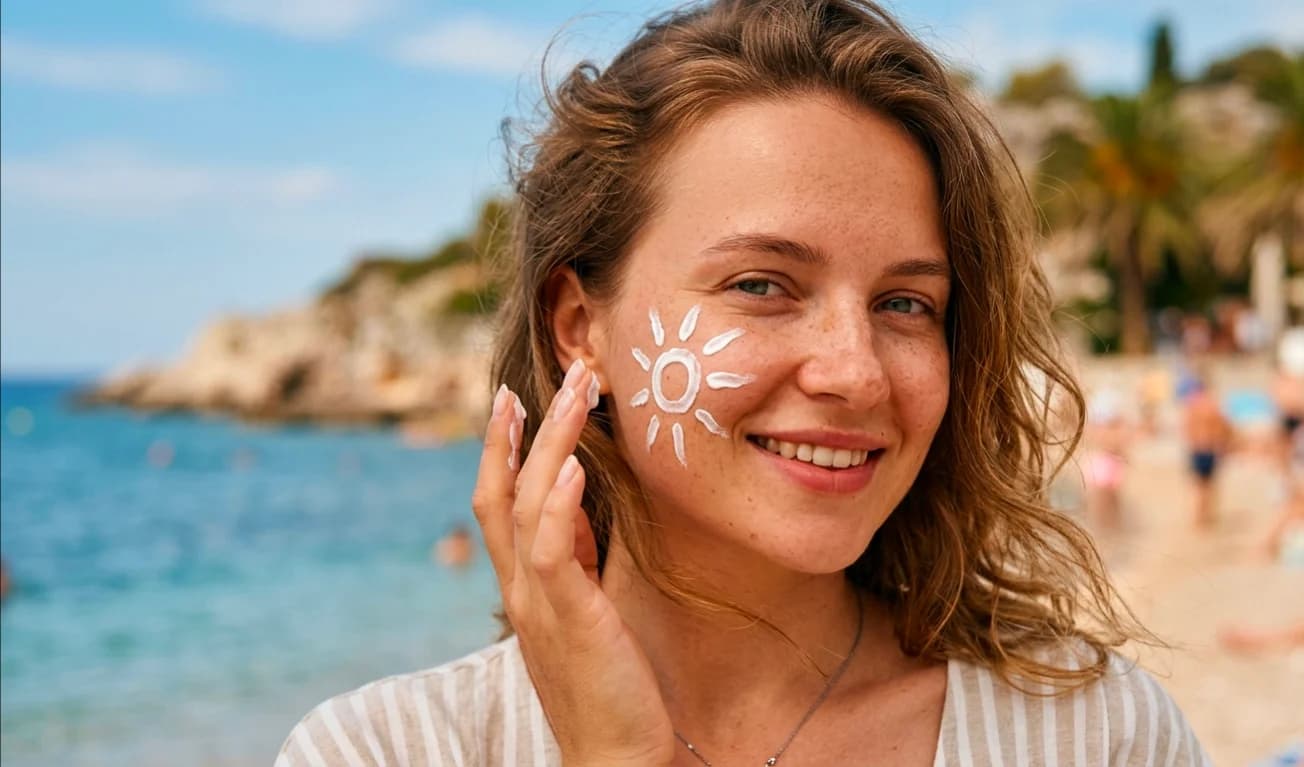
There are two categories of people. The first applies SPF 50 in February before a ten-minute walk to buy bread and feels practically invincible. The second slathers coconut oil on their face at the beach in July because "I have olive skin, it's fine." This article is for both groups — and for everyone who has ever stood in a pharmacy holding two different sunscreens and chosen based on which font they preferred.
SPF is probably the only skincare product that everyone believes they understand, and that almost everyone uses incorrectly. The number on the tube has become a shorthand for responsibility: SPF 50 means you're a serious person who takes care of themselves. But your skin didn't sign that particular agreement. And it has its own agenda.
The Comfortable Lie: Higher Number, Better Protection
If raw numbers told the whole story, the world's greatest chef would simply own the largest pot. SPF 50 filters approximately 98% of UVB radiation. SPF 30 filters 97%. The difference is one percentage point. Yet the majority of people reach reflexively for the fifty — because a lower number feels like negligence, like showing up to a rainstorm with a decorative umbrella.
But the number isn't the problem. The problem is everything we ignore around it.
Oily skin? A heavy SPF cream will sit on your face like a glazed pastry — not entirely unpleasant conceptually, but practically speaking a disaster. Sensitive skin or rosacea? Certain chemical UV filters can irritate in ways you've been misattributing to stress, diet, or that new face wash you can't quite bring yourself to throw away. Wearing make-up over your SPF? The layering order matters enormously — done incorrectly, it can reduce protection as effectively as not bothering at all.
And then there's application quantity — the detail nobody wants to confront. Dermatologists recommend 2mg per square centimetre of skin. For the face alone, that's roughly a quarter teaspoon. Research consistently shows most people apply half that amount, and then wonder why they have a suspiciously precise tan line exactly where their foundation had a gap.
What Your Skin Actually Needs (And Why Google Can't Tell You)
Individual SPF selection sounds like the kind of phrase that exists to sell premium products. In practice, it's rather more straightforward — it begins with knowing what you're actually working with.
Oily or acne-prone skin needs a lightweight, non-comedogenic texture — gel or fluid formulations that don't create a secondary skin on top of your actual skin. A heavy moisturising SPF here is not a solution; it's a different problem wearing a helpful label.
Dry or mature skin benefits from an SPF with active hydrating ingredients — ceramides, hyaluronic acid, or squalane. A light fluid at factor 30 that your skin will actually absorb beats a heavier SPF 50 that sits on the surface doing its best impression of plaster.
Sensitive skin or rosacea often reacts poorly to chemical UV filters — oxybenzone, avobenzone, octinoxate. These can trigger reactivity you've been diagnosing as allergies, hormones, or atmospheric bad luck. Mineral filters — titanium dioxide or zinc oxide — are the more forgiving option. Yes, the white ones. But contemporary formulations are considerably more sophisticated than the white paste from that 1990s beach holiday photograph.
Context matters too. Office-based, with brief outdoor excursions for lunch? SPF 30 in a comfortable texture with the occasional reapplication is genuinely sufficient. Weekends outdoors, cycling, gardening? SPF 50+ becomes relevant — but applied once at 8am and considered done is not the same thing as actual sun protection. Photoprotection is a routine, not a product. Routines require planning. They do not happen organically in the skincare aisle between choosing shampoo and remembering you need batteries.
What Actually Happens During a Consultation (Considerably Less Intimidating Than You Think)
A professional consultation about SPF doesn't involve slideshows or UV index charts or anyone saying "melanin" more than twice. It is, more accurately, a conversation — about your skin, your routine, the products you've tried and the ones currently sitting at the back of your bathroom cabinet, open, optimistic, and unused.
A cosmetologist assesses skin type, condition, sensitivity, and current hydration. They look for pigmentation — which has been patiently waiting for you to start taking sun protection seriously before it considers fading. They review what you're already using and whether the combination makes any logical sense.
And then they give you a specific recommendation. Not "SPF 50 is best" but "for your skin type, your lifestyle, and your current routine, this texture at this factor, applied like this." Concrete. Applicable. Not requiring a follow-up Google session at midnight.
Worth noting: proper photoprotection significantly extends the results of procedures — microneedling, chemical peels, carboxytherapy. The sun treats freshly treated skin with the same enthusiastic commitment a cat brings to a warm laptop: total focus, zero remorse.
FAQ — Thoughts You're Having Before Booking an Appointment
Do I actually need SPF in winter or when it's overcast?
Unfortunately, yes — and this will not be a popular answer. UVA radiation, the kind responsible for premature ageing, passes through clouds and glass. Including the window of your office where you sit for eight hours feeling safely indoors. Your skin doesn't know what month it is. Your future fine lines are already making plans accordingly. Winter doesn't demand SPF 50 — a lighter factor in an appropriate texture is vastly preferable to the technically correct product you won't use because it feels too heavy in January.
I have darker skin — do I still need SPF?
Darker skin contains more melanin, which provides a degree of natural protection — but not complete immunity. Dermatologists recommend photoprotection for every skin tone without exception. Pigmentation and uneven skin tone appear across all phototypes, and UV exposure is a remarkably efficient co-author of both. You need SPF — likely just a different type than you've been assuming.
Can make-up with SPF replace a dedicated sunscreen?
In theory, yes. In practice, it depends on volume. The amount of foundation or tinted moisturiser that looks cosmetically reasonable is almost always thinner than the amount needed to provide meaningful protection. Cosmetologists describe this as an umbrella with holes — functional in appearance, ineffective in rain. The sensible approach: SPF as your base, make-up with SPF as an additional bonus, not as the primary strategy.
How do I know if my current SPF isn't right for me?
Your skin will communicate this with considerable directness: blocked pores, persistent oiliness, tightness on application, or the opposite — the product disappears within the hour and you look as though you applied nothing at all. A good SPF maintains its presence, feels comfortable against the skin, and doesn't dissolve at first contact with minor effort. If yours does none of this — a consultation will cost less than another round of trial-and-error purchasing.
SPF is rather like home insurance. Everyone knows they should have it. Few are confident they have the right one. Nobody reviews it until something goes wrong.
Unlike insurance, however, your SPF routine can be changed without paperwork, phone calls, or a six-week waiting period. It simply requires knowing what your skin actually needs — which is best determined by someone who can see it in person and has no particular interest in selling you whichever product has the highest margin.
If you have ever stood in a pharmacy holding two sunscreens and chosen based on the label design, perhaps it's time to try a different method. Victoria in Plzeň is happy to help you find the right one — emphasis on right, not most popular.